Posts

HILLARY VERSUS TRUMP: IT WAS NEVER SO BAD

Image
Mukesh Devrari  When this author woke up in the morning and opened CNN, the first fifty minutes of Presidential debate in America was already over. He witnessed the ideological onslaught of Republic candidate by very healthy Democratic Party candidate Hillary Clinton in the remaining portion of the debate. Sitting here in this small city of Dehradun, he also felt like commenting on US elections. After all US President will also decide how India will look like in the future. Democrats are good at making populist signals. In the first Presidential debate Hillary Clinton tried to make remarks in favour majority. She tried her best to appear as if her priority is ordinary Americans, not American corporate houses. So, as a most unpopular Presidential candidate from Democratic Party she threw her old net for catching American votes. All her arguments can be summed up in a few lines. Throughout the debate, Hillary outlined working for the interests of the ordinary America...

CURRENT KASHMIR CRISIS IS NOT A PAKISTANI CREATION

Image
 Photo courtesy Mukhtar Khan, NAMNEWSNETWORK Mukesh Devrari Pakistani newspapers are obsessed with India these days. They are giving too much importance to the speeches of their leaders and statements of their bureaucrats. Reading them is like listening to someone totally inebriated and talking incessantly without caring what he or she means. Former ambassadors and public intellectuals in Pakistan through their writings are encouraging their government to raise Kashmir issue. They think it will encourage Kashmiri Muslims to protest more vehemently against India.  If their version is to be believed, Pakistan has successfully cornered India on Kashmir in United Nations and rest of the world and assimilation of Kashmir in Pakistan is days away. In India, this perspective appears extremely ambitious and unrealistic.  India lived peacefully for twenty years after 1971 war. During the 1990s Pakistan started creating troubles for India again by encouraging ar...

MODERNIZATION IN DIGITAL ERA

Image
 Photo Courtesy - Nirmal Poddar Mukesh Devrari Modernization is a series of transitions from primitive subsistence economies to technology intensive industrialized economies, from subject to participant political cultures, from closed ascriptive status systems to open achievement oriented systems, from extended to nuclear kinship units, from religious to secular ideologies and so on. (Tipps, 1973, 204) In other words, every characteristic of the modern western nation-state is a symbol of modernity. Modernization is generally referred as an ongoing process to improvise the lives of people in third world countries. But another section also interprets it as a conspiracy against the impoverished population of third world countries. Acceptance of modernization is interpreted as accepting western superiority and dominance. Photo Courtesy - Nirmal Poddar Max Weber in his book, ‘Protestant Ethic and the Spirit of Capitalism’ held Asian cultural values responsible for t...

DEMOCRATIZATION OF INTERNET IS AN UNFINISHED BATTLE

Image
Photo - Nirmal Poddar Mukesh Devrari  The democratization of the internet means everyone who has an online presence should get the chance to make his or her voice heard equally. It must happen at both levels - at the level of individual and at the level of the nation-state.  Internet is a complex phenomenon. Its social, political and economic impacts have not been studied yet. It inserts pressure at many points at a single point of time. It is difficult to capture its working with all its complexities. DEMOCRATIZATION OF INTERNET AT REGIONAL LEVEL In an ideal situation everyone should have the right to use the internet to connect with other members of society for free. It is a positive right. It can only be ensured by providing access to all. But to provide access to all cannot be a standalone exercise. It is attached to other determinants of economic development. Currently, only well off sections have access to the internet. It has increased the social, po...

CONTOURS OF DEVELOPMENT

Image
Photo - Village Kurar, Chamoli District, Uttarakhand Mukesh Devrari  Development is a wide concept. Developed nation means a nation where people have a better life. Anything and everything which contributes in improvising the lives of masses should be included in the wider definition of development. It has many determinants. Broadly all determinants can be divided into two categories. Firstly, tangible determinants which make our physical presence on earth comfortable. Secondly, non-tangible determinants which make our psychological presence on earth comfortable. Most developing countries are lacking either both categories of determinants of development or any of them severely.  India lacks tangible determinants more than it lacks intangible determinant. Our population lacks access to basic necessities of life like food, shelter, education, jobs and healthcare.  It is terrible thing to argue for intangibles in a nation state which could not provide ne...

MARCHING TOWARDS UNSUSTAINABLE FUTURE

Image
Photo Courtesy - Nirmal Poddar  Mukesh Devrari  The earth has enough resources for our needs – not for our greed – Mahatma Gandhi In the early nineteenth century renowned political economist Thomas Robert Malthus tried to point out that the incremental growth in food production can never match the food requirements of an exponentially growing population. He suggested that a better way to deal with the problem is to open sewer lines. It would lead to the spread of diseases and the result will be an immediate reduction in population. Today Malthus can be charged with underestimating the resilience of human beings as a biological entity against the odds of life and nature. Lot has changed since then. Requirements of human beings now go far beyond mere food. The lifestyle of westerners suggests earth has enough not only to fulfil our needs but also our greed. It seems each one of us can have things in abundance. The byproduct of modern man’s quest for progre...

UNIFORM CIVIL CODE IS NOT ABOUT HINDU DOMINANCE

Image
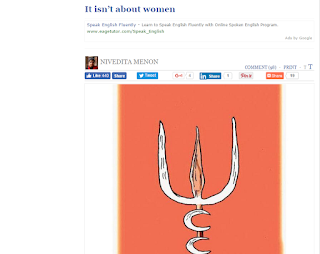
Screen shot from the website of The Hindu.  Mukesh Devrari In the morning I came across a column written against uniform civil code in the editorial page of ‘The Hindu’. The essay was written by Nivedita Menon. She is a professor at JNU, New Delhi and describes herself as a feminist scholar. In her column titled ‘It isn’t about the woman’, she gave reasons to support the continuation of Sharia based Muslim personal law in India and argued against prohibiting polygamy and triple talaq. She described the Uniform Civil Code as a Hindu agenda to impose Hindu laws on Muslims. I could resist myself and scribbled a few lines to critique her arguments. It is important to critically examine her grotesque narrative on the issue. She is denying democratic space available to Muslim women in secular democracies like India. According to her even in secular democracies if Muslims women need any right, they should find it within the Islamic faith.  Recently a Muslim w...