Posts

Showing posts with the label Economy

CAN WE LEARN FROM TRUMP’S AMERICA FIRST POLICY AND FIGHT US MONOPOLIES?

Image
Mukesh Devrari  India must learn from Donald Trump. He is a true patriot who talks straight. His straight talking uncovers the western sophistication and ideology. West has only one ideology. It is the national interest. Over the last few decades, this national interest turned into white men’s interest. The US treated itself as a large entity representing the interests of Europe, Australia, and New Zealand. Japan and South Korea were late entrants in the club. Trump has simply declared the US will abide by the rule-based world order if the existing rules fulfil US interest. If the rules established by the US a few decades back are not compatible with contemporary US national interest, then it has no interest in abiding by those rules. Earlier US regimes were no different, but they were more sophisticated and resorted to manipulative tactics after taking its allies into confidence. On a trade dispute with China, the US has declared that if trade balance was not corre...

CONTINUATION OF WESTERN HEGEMONY, INDIA WITHOUT AN E-RETAILER

Image
Mukesh Devrari  Western powers exploited third world countries by occupying them. British Empire was an economic project, not a racial one. It ensured that the UK becomes the richest nation on earth. Slowly all nation-states demanded independence. To maintain their economic supremacy western powers needed unbridled access to markets in third world countries. Without this access, the west cannot keep its economic supremacy intact.  Western powers created a propaganda structure. They invented the economic order.  They created a set of rules and declared them universally applicable and essential for the progress of all nations on earth. West encouraged third world countries to adopt liberal market policies. It preached by practising it. Free market doctrine claimed that western nations are open to all kinds of investment from around the globe. They claimed that there is no discrimination in the west. Whether a company interested in doing business in the ...

DOES INDIA NEEDS DICTATORSHIP FOR PROGRESS?

Image
Dust and smoke billows out from a residential house which was blown up during a gunfight between militants and Indian soldiers in Durbagh village of Chadoora, 15 km from Srinagar, the summer capital of Indian Kashmir on March 28, 2017. One militant was killed and an Indian soldier injured during a 10-hour-long gunfight. Three civilians were also killed and at least 15 injured during clashes near the gunfight site. Photo courtesy Agencies SOURCE - NAM NEWS NETWORK Mukesh Devrari First, Young generation of Indians are least bothered about freedom and liberty ensured in this country to each and every citizen. They feel too much of freedom is hampering decision making and implementation of policies. Students, mostly upper caste, who have never seen any hardships in life, have been coaxed to believe that democracy in India is a barrier in our rapid progress and economic development. These emerging militant nationalists are not ready to accept that almost all rich nations o...

CONNECT THE UNCONNECTED, INDIA WILL DEVELOP FASTER

Image
Mukesh Devrari The question of access to the information world cannot be seen in isolation. It is impossible for the nation-state to provide universal access to the internet and to various services through it with changing the wider situational realities of the common masses.  Is it possible to provide smartphone and computer to a population which does not have anything to eat? Is it possible to provide access to the internet to the 25 per cent population which is illiterate? Is it possible to provide access to the internet for free of cost to each and every citizen? Even if universal access to the internet is ensured for free in third world countries like India, what purpose it will serve if more than 90 of the content available on the internet is in non-Indian languages. These are the hard questions which need hard answers. Recent reports in newspapers also highlight another disturbing report. Indian railways provided free internet services in many railway platforms ac...

MODERNIZATION IN DIGITAL ERA

Image
 Photo Courtesy - Nirmal Poddar Mukesh Devrari Modernization is a series of transitions from primitive subsistence economies to technology intensive industrialized economies, from subject to participant political cultures, from closed ascriptive status systems to open achievement oriented systems, from extended to nuclear kinship units, from religious to secular ideologies and so on. (Tipps, 1973, 204) In other words, every characteristic of the modern western nation-state is a symbol of modernity. Modernization is generally referred as an ongoing process to improvise the lives of people in third world countries. But another section also interprets it as a conspiracy against the impoverished population of third world countries. Acceptance of modernization is interpreted as accepting western superiority and dominance. Photo Courtesy - Nirmal Poddar Max Weber in his book, ‘Protestant Ethic and the Spirit of Capitalism’ held Asian cultural values responsible for t...

CONTOURS OF DEVELOPMENT

Image
Photo - Village Kurar, Chamoli District, Uttarakhand Mukesh Devrari  Development is a wide concept. Developed nation means a nation where people have a better life. Anything and everything which contributes in improvising the lives of masses should be included in the wider definition of development. It has many determinants. Broadly all determinants can be divided into two categories. Firstly, tangible determinants which make our physical presence on earth comfortable. Secondly, non-tangible determinants which make our psychological presence on earth comfortable. Most developing countries are lacking either both categories of determinants of development or any of them severely.  India lacks tangible determinants more than it lacks intangible determinant. Our population lacks access to basic necessities of life like food, shelter, education, jobs and healthcare.  It is terrible thing to argue for intangibles in a nation state which could not provide ne...

MARCHING TOWARDS UNSUSTAINABLE FUTURE

Image
Photo Courtesy - Nirmal Poddar  Mukesh Devrari  The earth has enough resources for our needs – not for our greed – Mahatma Gandhi In the early nineteenth century renowned political economist Thomas Robert Malthus tried to point out that the incremental growth in food production can never match the food requirements of an exponentially growing population. He suggested that a better way to deal with the problem is to open sewer lines. It would lead to the spread of diseases and the result will be an immediate reduction in population. Today Malthus can be charged with underestimating the resilience of human beings as a biological entity against the odds of life and nature. Lot has changed since then. Requirements of human beings now go far beyond mere food. The lifestyle of westerners suggests earth has enough not only to fulfil our needs but also our greed. It seems each one of us can have things in abundance. The byproduct of modern man’s quest for progre...

LAND ACQUISITION SHOULD BE SIMPLIFIED FOR RAPID INDUSTRIALIZATION

Image
Mukesh Devrari During the tenure of Congress, party country came to stand still. It was described as policy paralysis. There were many reasons. During its tenure, Congress decided to hear the complaints of farmers that their land is being acquired by state governments arbitrarily for the benefit of corporate groups.  In West Bengal CPIM decided to acquire land from farmers for failed Tata small car project. Farmers agitated against government fiercely.  Congress as a true left-leaning political party provided relief to farmers at the cost of long term benefits to the nation. For some, it was very encouraging to see that the mainstream political party in India is willing to take the side with the weaker sections of society.  According to the detractors of the Congress party, this decision led to the complete stagnation in developmental projects. It became impossible for states to acquire land. Many of the Chief Ministers in congress govern state opposed the bill...

WHAT DOES INDIA EXPECTS FROM THE NEW PRIME MINISTER?

Image
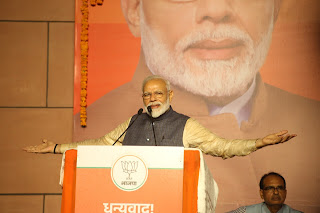
Mukesh Devrari  There was not much to read in the victory speeches of the man of the moment Narendra Modi. He led BJP to its biggest victory. BJP won staggering 283 seats and Congress has to contend with 43 seats. Even in 1977 general elections, which were held immediately after an emergency, Congress could win 154 seats in Lower House of parliament out of 543. BJP ideologue Balbir Punj said that he had never imagined that in his lifetime BJP would come to power on its own. If BJP leaders could not imagine this spectacular win, how could others? So far, the highest score of BJP was 182 seats in 1999 general elections under the charismatic leadership of A.B Vajpayee. The Modi is now our Prime Minister. The focus of this article is to highlight an ideological structure, if there was any, in his victory speech. During his campaigns, Modi promised that development will be his priority. The entire corporate world stood behind him because as a Chief Minister of Gujarat he en...

PRIVATIZATION OF HIGHER EDUCATION IS EVIL IN THIRD WORLD COUNTRIES

Image
This author has written this news (in picture) in Garhwal Post in the year 2006. It is a small newspaper published from Dehradun.    Mukesh Devrari It started in the early nineties. It was the part of the initiation of economic reform juggernaut. Successive governments in India accepted the policy prescription from neo-liberal thinkers that the education sector should be opened for private players. All opposite suggestions were dismissed as leftist arguments, which had perhaps lost their potency with the disintegration of the Soviet Union. Humanist thinkers reminded the government that it must keep the health and education sector in its own hands. Hospitals and Universities cannot be allowed to function with the sole intention of making a profit, but all alternative discourse was  out-rightly  rejected. The result was an innumerable number of private colleges and universities cropped up around the country. Some of them are churning trained technical ...